Locality guide · 9 min read
OMR or GST Road: Where ₹1 Crore Goes Further in Chennai
Two roads leave Chennai for the south, and a ₹1 crore budget buys a different life on each. How to choose between OMR and GST Road.
09-Jul-2026
Ask ten people in Chennai where to buy a first home under ₹1 crore and most of them will point south. Then the room splits in two. Half will say OMR, because that is where the offices are, and the other half will say GST Road, because that is where their parents' friends bought in 2009 and have never once complained. Both halves are right. Neither is helpful.
So here is the longer answer, written the way we would walk you through it on a site visit: one road at a time, with the questions that actually decide it.
Two roads, one budget
Why do these two roads come up together at all? Because they run roughly parallel out of the city, they both carry the bulk of Chennai's new residential supply to the south, and a budget of ₹1 crore sits comfortably on both. That last point is the trap. When the money fits everywhere, people stop choosing with the money and start choosing with a brochure.
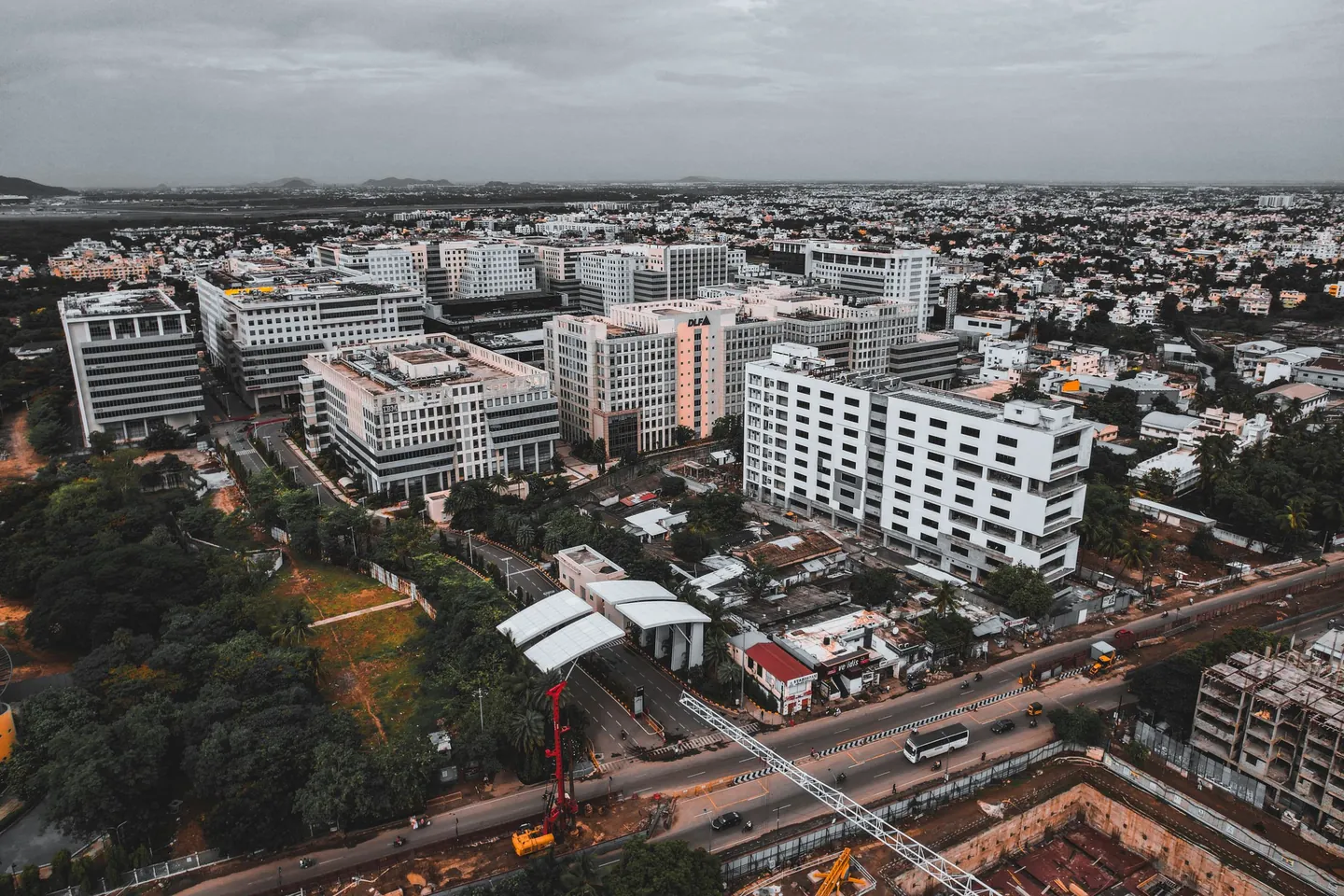
OMR, formally Rajiv Gandhi Salai, is the IT corridor. It begins near Madhya Kailash, runs past Perungudi, Thoraipakkam and Sholinganallur, and keeps going through Navalur, Siruseri, Padur and Kelambakkam towards Mahabalipuram. Its identity was built by office campuses, and its housing followed the badge-swipe.
GST Road, the Grand Southern Trunk Road, is older and broader in purpose. It leaves the city past the airport, runs through Pallavaram, Chromepet and Tambaram, then on to Perungalathur, Vandalur, Guduvanchery and Chengalpattu. Its identity was built by the railway, by schools and colleges, and by families who wanted a bit more house for the same money.
One road was built for commuting. The other was built for living. That is an oversimplification, of course – but it is a useful one to start with.
What ₹1 crore looks like on OMR
On OMR, the budget tends to buy you location first and square footage second. Closer to the city, around Perungudi and Sholinganallur, ₹1 crore is usually a compact two bedroom in a large community, and sometimes a tight three. Go further south to Navalur, Padur, Siruseri or Kelambakkam and the same money stretches into a larger two, or a three bedroom with room to breathe.
What you are paying for, in either case, is the commute you do not have. Somebody who works in a Siruseri or Sholinganallur campus and lives ten minutes away has, in effect, bought back two hours of every working day. Over a decade that is a lot of dinners at home. It is also why rental demand on OMR follows the IT payroll so closely: a tenant who works on the road will pay for a flat on the road.
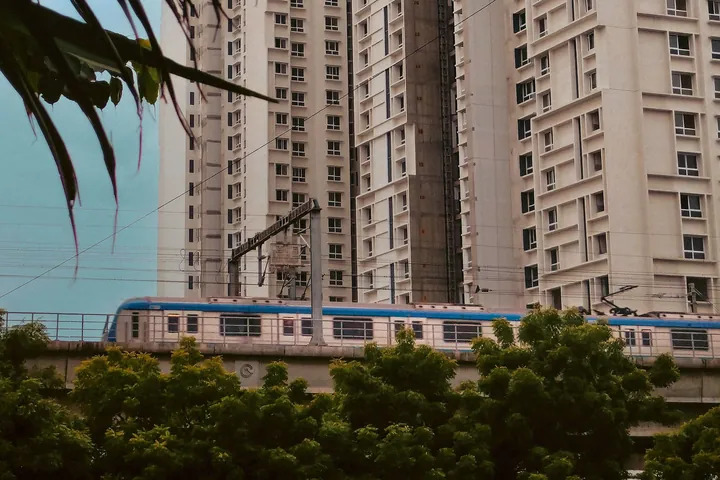
The catch is the corridor itself. OMR traffic at peak hours is not a rumour, and the stretch between Thoraipakkam and Sholinganallur can test the patience of a saint. Metro work under Phase 2 has been running along the road for some time; when it is complete, it should change the arithmetic of living further south, but a promise in a newspaper is not a train at the platform. Buy for the road as it is, and treat the metro as upside rather than as the reason.
There is also the question of water and ground. Parts of OMR sit on low land close to the Pallikaranai marsh, and some pockets near Semmancheri and Perumbakkam have a history every long-time resident will tell you about without being asked. That is not a reason to avoid the area. It is a reason to ask which side of a particular street floods, and to ask it in November rather than in May.
What ₹1 crore looks like on GST Road
On GST Road, the same budget tends to buy you space first. Around Tambaram and Perungalathur, ₹1 crore can mean a generous three bedroom in an established neighbourhood. Push on to Vandalur, Guduvanchery and towards Chengalpattu, and the conversation starts to include independent homes, villas and plots in gated layouts.
The road's great strength is that it is connected in more ways than one. The suburban railway runs alongside it from Beach to Tambaram and on to Chengalpattu, which means a large part of the road is a train ride away from the city rather than a drive. The airport sits at its city end. The Kilambakkam bus terminus, opened at the end of 2023, has made the stretch around Vandalur and Urapakkam a starting point for travel to the rest of Tamil Nadu. And the schools, colleges and hospitals that grew around Tambaram and Chromepet over decades mean that a family moving in does not have to wait for a neighbourhood to arrive.
Further south, Mahindra World City near Chengalpattu and the industrial belt around Maraimalai Nagar give the outer stretch an employment base of its own, which is not the same as OMR's but is not nothing either.
The catch here is different. GST Road is a national highway and behaves like one, with heavy goods traffic and bottlenecks around Tambaram and Perungalathur that have outlived several rounds of flyovers. And it has its own flood history: Mudichur, just off the road near Perungalathur, became a household name in December 2015 for all the wrong reasons. Low land is low land, whichever road it sits beside.
The commute question, asked properly
Most people ask "how far is it from my office?" That is the wrong question, or rather half of one. The full question has three parts: how far, by what, and at what hour.
Take two hypothetical buyers. Karthik writes software in a Siruseri campus and his wife Deepa teaches at a school in Chromepet. If they buy in Navalur, Karthik is fifteen minutes from work and Deepa has a long cross-country drive every morning. If they buy in Tambaram, Deepa walks to the station and Karthik crosses over to OMR on a road that was not designed for the purpose. Neither answer is wrong. But a couple that only looks at one office will buy a house that works for half the household.
The honest move is to drive the commute yourself, both ways, on a weekday, at the hour you would actually make it. Not on a Sunday afternoon with the developer's driver, who knows every shortcut and none of the problems. We will happily do this with you, and we will happily tell you when a project that looks perfect on the map turns out to be forty minutes from anywhere at 9 am.
Ready homes, under-construction homes and plots
Both roads offer all three, but the mix is not the same.
OMR's under ₹1 crore market is dominated by apartments in large communities, many of them under construction, from developers who know that the IT buyer wants a clubhouse, a gym and a lift that works. Ready-to-move stock exists, especially in older communities closer to the city, and often comes through resale.
GST Road has more variety. There are large apartment communities here too, but there is also a deep market in independent homes, villas and plotted layouts, especially beyond Vandalur. A plot is a different decision altogether: you are buying land, and the paperwork that comes with land in Tamil Nadu deserves its own conversation, which is why we wrote a whole note on patta, chitta and the encumbrance certificate.
Whichever you lean towards, the choice between paying now for something finished and paying in stages for something promised is a decision in its own right. We have set out how we think about it in under construction or ready to move.
What the brochure will not tell you
Every project on either road will tell you it is "minutes from" something. Minutes is doing a lot of work in that sentence. Here is what we check instead, on both roads, before we put a project in front of anybody.
First, the approach road. The last kilometre matters more than the first twenty. A project set back from the highway down a narrow road with no stormwater drain is a different home in the monsoon than one on a wide, paved approach.
Second, the registration. Every project of the size that matters here should be registered with TNRERA, and the registration page tells you far more than the brochure about approvals, timelines and progress. We have written about what a TNRERA registration actually checks, and just as importantly, what it does not.
Third, the area. A price per square foot means nothing until you know which square feet. Two flats at the same quoted figure can differ by hundreds of square feet of usable space once you strip out the common-area loading. Our note on carpet, built-up and super built-up area explains how to read a cost sheet without being read by it.
Fourth, the neighbours who are not there yet. On the outer stretches of both roads, the land next to your project may be empty today. Somebody will build on it eventually. Ask what it is zoned for.
The Saturday test
A home is not only where you sleep on weeknights. It is where you buy vegetables, find a paediatrician at 10 pm, and take an elderly parent for a blood test without a forty-minute drive. So after the weekday commute, do the Saturday one.
On OMR, the everyday has caught up with the offices around Sholinganallur and Navalur, where supermarkets, hospitals and schools now sit within easy reach of most large communities. Further south, around Padur and Kelambakkam, it is thinner, and some communities still lean on their own clubhouse and convenience store for the small things.
On GST Road, the everyday is older and deeper. Tambaram and Chromepet have markets, hospitals and schools that have served three generations, and the railway puts the rest of the city within reach. Beyond Vandalur it thins out here too, though Guduvanchery has grown a commercial life of its own.
Spend a Saturday morning in the neighbourhood, not the show flat. You will learn more in three hours than in three brochures.
So which one?
Here is the short version, for anybody who scrolled straight to the end.
Choose OMR if your working life is on OMR, if rental demand from IT tenants matters to you, and if you would rather have a smaller home ten minutes from work than a larger one forty minutes away. Look hard at the stretch from Sholinganallur to Kelambakkam, where the budget still buys a sensible two or three bedroom.
Choose GST Road if your family's life is spread across the city, if the railway is part of how you move, if you want more house for the money, or if you are open to a villa or a plot. Look hard at Tambaram and Perungalathur for established neighbourhoods, and at Guduvanchery and beyond for space.
And if you are torn, there is a third road worth a look. The western suburbs around Porur and Poonamallee have quietly become a serious alternative, with their own metro story and their own trade-offs. We have written that one up separately as well: west Chennai, from Porur to Poonamallee.
The decision behind the decision
The real choice is rarely between two roads. It is between two versions of the next ten years. One is built around a commute; the other is built around a household. A good home is the one where the roads you drive every day lead somewhere you want to be – which sounds like a greeting card, but is also the most practical test we know.
There is a word for the moment a city forces you to pick between two good options that pull in opposite directions: bifurcation. Chennai's south does it to almost every first-time buyer. The trick is not to resist it. The trick is to choose with your calendar open, not your brochure.
We work with projects on both roads, so we have no reason to push you down either one. What we can do is put the two side by side for your budget, your family and your commute, drive them with you on a weekday morning, and check the papers on whichever one wins. When you are ready to look, tell us what you are looking for and we will start with the road, not the brochure.